Late Season Snow Signal Emerges Across Ohio in HRRR Model Data Valid Friday Morning May 1, 2026 Raising Surprise Winter Precipitation Concern for Northeast Ohio Communities
OHIO — A surprising and unwelcome late-season winter precipitation signal emerged in HRRR 3 km model data initialized April 30, 2026, with at least one model suggesting snow as a possible precipitation type across portions of Ohio on Friday morning, May 1, 2026, catching forecasters attention as an unexpected development for a region well into the spring season.
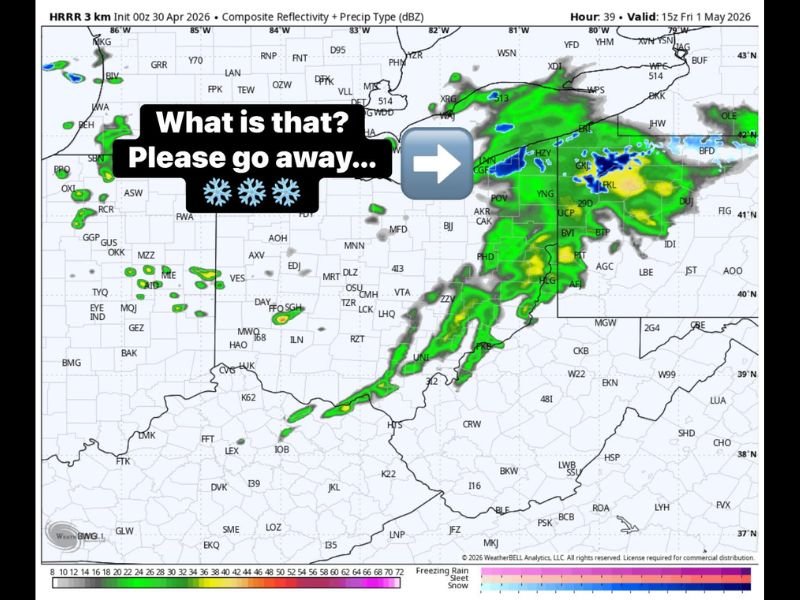
The HRRR model valid at 15Z Friday, May 1, 2026 showed a complex precipitation pattern pushing across Ohio, with the model depicting a mix of rain, sleet, freezing rain, and snow signatures across northeastern Ohio and surrounding areas as an organized storm system tracked through the region during the Friday morning timeframe.
Model Data Hints at Snow Possibility for Northeast Ohio
The precipitation type legend on the HRRR model output clearly showed snow and sleet signatures concentrated across the northeastern Ohio corridor, with blue and purple reflectivity returns indicating frozen or mixed precipitation alongside the more widespread rain coverage depicted across central and southern portions of the state.
The appearance of a snow signal in late April and early May across Ohio represented a notable and attention-grabbing model solution, raising questions about how the atmosphere would ultimately resolve the precipitation type question across the affected northeastern Ohio communities through the Friday morning window.
Complex Storm System Tracks Across the Ohio Valley
Beyond the snow question, the broader storm system depicted in the HRRR model showed an organized and widespread precipitation complex pushing across the Ohio Valley region. Significant reflectivity returns were visible stretching from central Ohio northeastward through the Youngstown, Akron, and Canton corridor and extending into western Pennsylvania, reflecting the scope and scale of the Friday morning storm system moving through the region.
The complexity of the precipitation setup, with multiple precipitation types possible simultaneously across different elevation and temperature zones within Ohio, added forecasting difficulty to an already unusual late-season weather event.
Late Season Timing Adds Element of Surprise
The emergence of a potential snow signal in early May across Ohio underscored the unpredictable nature of late spring weather patterns across the Great Lakes and Ohio Valley region, where cold air intrusions can occasionally penetrate far enough south and east to support brief winter precipitation events well into the meteorological spring season.
While the ultimate outcome of the Friday morning precipitation type remained dependent on how atmospheric temperatures evolved through the event, residents across northeastern Ohio were advised to monitor updated model guidance closely through Thursday as forecasters tracked the evolving and potentially wintry Friday morning storm system.
For continuing coverage of weather events and critical storm analysis across the United States, visit SaludaStandard-Sentinel.com.