188500 Birds in Flight Detected Over Birmingham Alabama by Doppler Radar Saturday Night Traveling North at 28 MPH and 3300 Feet Altitude Tracked by Cornell University Birdcast
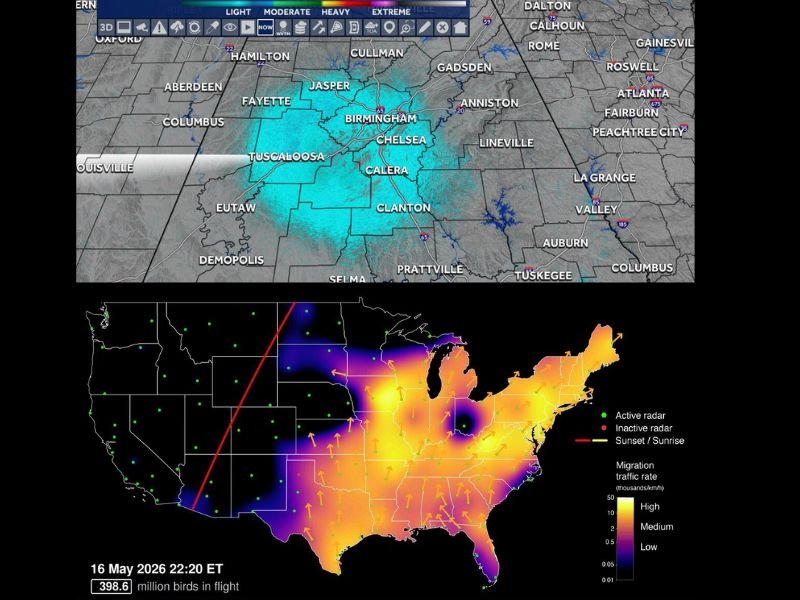
BIRMINGHAM, AL — An estimated 188,500 birds were detected in active flight over the Birmingham, Alabama metro area at 9:20 PM Saturday evening, according to Cornell University’s Birdcast Live migration traffic data. The massive bird movement, captured on dual-pol NEXRAD radar, shows thousands of birds traveling northward at 28 miles per hour at an altitude of approximately 3,300 feet, producing the distinctive blue circular radar signatures that blanketed live radar screens across the region Saturday night.
Dual Pol NEXRAD Radar Captures Thousands of Birds in Flight Over Central Alabama
Live radar imagery captured at 9:42 PM Saturday shows a broad and striking blue circular return centered over the Birmingham metro area and extending outward across surrounding counties including Tuscaloosa, Jasper, Cullman, Chelsea, Calera, and Clanton. The radar return, registering in the light to moderate range on reflectivity scales, is entirely composed of migrating birds rather than precipitation, with zero lightning recorded across the region confirming the absence of any storm activity producing these signatures.
The circular bloom pattern expanding outward from the Birmingham area is a well documented radar phenomenon during peak spring migration nights, occurring as large numbers of birds take flight simultaneously after sunset and disperse outward into their northward flight paths at altitude.
Cornell University Birdcast Data Confirms Flight Direction Speed and Altitude
Cornell University’s Birdcast Live migration traffic platform, which utilizes the same dual-pol NEXRAD radar data used for weather forecasting, provided precise flight metrics for the Birmingham metro migration event Saturday evening. The 188,500 birds estimated in flight at 9:20 PM were confirmed moving due north at a ground speed of 28 miles per hour and maintaining a flight altitude of 3,300 feet above the surface.
Bird researchers developed the capability to track migration patterns using dual-pol NEXRAD radar by identifying the unique polarimetric signatures that birds produce compared to precipitation, allowing for real time monitoring and quantification of migration events across the entire continental United States during peak spring and fall seasons.
Nationwide Migration Activity Visible Across Multiple Radar Sites Saturday Night
Beyond the Birmingham metro concentration, the broader national migration picture Saturday night showed significant bird flight activity spread across a wide portion of the central and eastern United States. A national migration traffic map shows the heaviest concentrations of bird flight activity stretching across the central corridor of the country, with Birmingham sitting within one of the most active zones of the evening migration pulse.
The scale of Saturday night’s migration activity across Alabama and surrounding states reflects the peak nature of the spring migration season during mid May, when large numbers of songbirds, shorebirds, and other migratory species move northward en masse toward their summer breeding grounds across the northern United States and Canada.
For continuing coverage of major weather and environmental events across the United States, visit SaludaStandard-Sentinel.com.