Scientists Capture Rare Ultraviolet Sparks Emitting From Treetops During Thunderstorms, Revealing Hidden Electrical Activity in Nature
UNITED STATES — Scientists have documented a surprising natural phenomenon in which treetops emit faint ultraviolet sparks during thunderstorms, revealing a hidden electrical process occurring in forests when storm systems pass overhead.
Researchers recently captured the event on camera in nature, marking the first time the unusual electrical activity has been directly filmed in the wild.
Ultraviolet Sparks Observed at the Tips of Tree Leaves
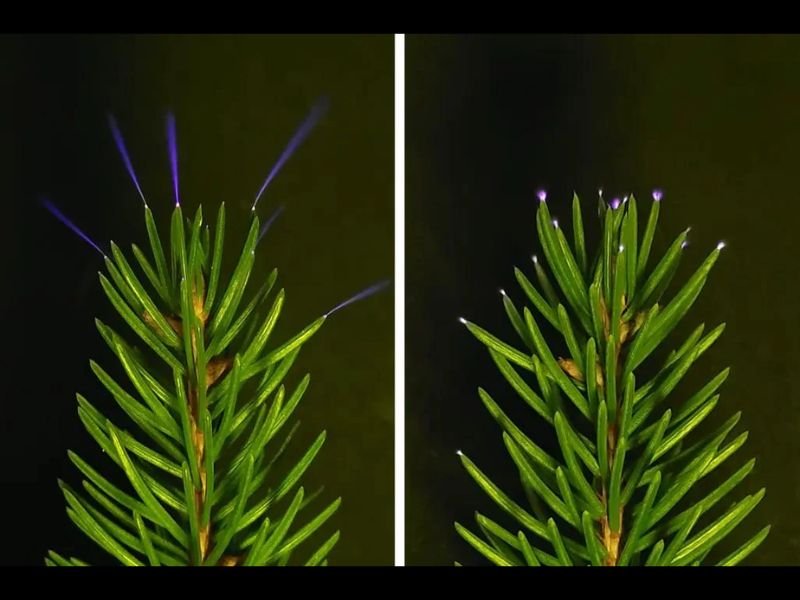
The newly documented phenomenon shows tiny flashes of ultraviolet light appearing at the tips of leaves and branches during active thunderstorms.
Although invisible to the human eye under normal conditions, specialized imaging equipment allowed researchers to observe the sparks clearly.
The glowing flashes appear briefly at the highest points of trees, especially along thin needles and leaves where electrical charge tends to accumulate.
Scientists say these small sparks resemble tiny electrical discharges similar to static electricity.
Storm Conditions Trigger Electrical Activity Around Trees
According to researchers studying the event, thunderstorm conditions create strong electrical fields in the atmosphere.
As lightning and charged storm clouds move overhead, electrical energy builds up between the ground and the sky. Tall objects such as trees become natural conductors for this energy.
The buildup of electrical charge can cause small bursts of energy to release from the tips of leaves and branches, producing faint ultraviolet sparks.
This process is similar to a phenomenon known as corona discharge, where electricity escapes into the surrounding air in tiny flashes.
Why Scientists Were Surprised by the Discovery
While scientists have long suspected that electrical discharges could occur around vegetation during storms, the phenomenon had rarely been observed directly in natural environments.
Capturing the sparks on camera required specialized ultraviolet-sensitive equipment capable of detecting extremely faint flashes of light.
The successful filming of the sparks provides new insight into how plants interact with atmospheric electricity during severe weather.
What the Discovery Could Mean for Future Research
Researchers believe this discovery may help improve scientific understanding of how thunderstorms influence ecosystems and plant life.
The electrical interactions between vegetation and the atmosphere may play a role in processes such as chemical reactions in the air, energy transfer during storms, and even forest fire risks under certain conditions.
Further research may also explore whether similar electrical activity occurs in other types of vegetation, including grasslands and agricultural crops.
The discovery highlights how many natural processes during storms remain invisible to humans without advanced technology, even though they occur frequently in the natural world.
Have you ever witnessed unusual natural phenomena during a thunderstorm? Share your experience and join the discussion with readers at SaludaStandard-Sentinel.com.