Paper Wasps Can Recognize and Remember Individual Human Faces Using the Same Brain Process as Humans Despite Having a Brain Smaller Than a Grain of Rice
ANN ARBOR, MI — Before you swat at the paper wasp hovering near your porch this summer, consider this unsettling scientific fact — it may already know exactly who you are. Decades of research led by scientists at the University of Michigan and Cornell University has confirmed that paper wasps possess a facial recognition ability so sophisticated it mirrors the same holistic processing mechanism used by the human brain, despite operating on a brain containing fewer than one million cells compared to the 86 billion found in a human brain.
The Discovery That Redefined Insect Intelligence
Wasps and humans have independently evolved similar and very specialized face-learning mechanisms despite the fact that everything about the way we see and the way our brains are structured is different, said researcher Michael Sheehan who worked with evolutionary biologist Elizabeth Tibbetts on the face recognition study. That is surprising and sort of bizarre.
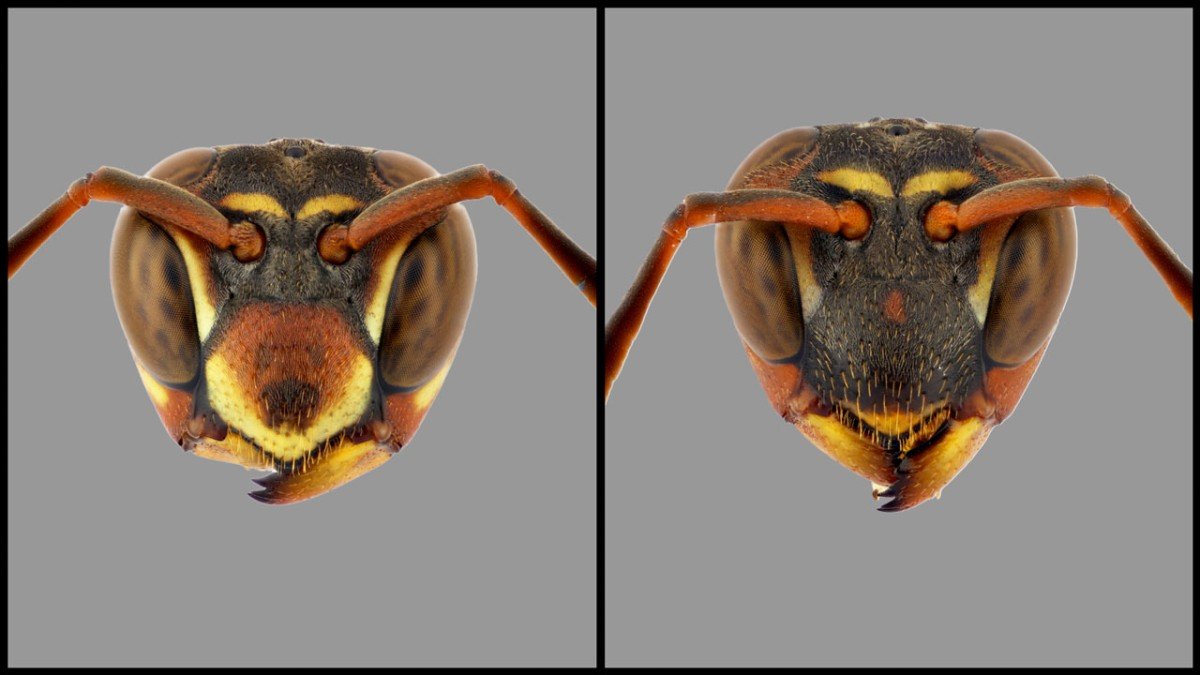
Scientists discovered that Polistes fuscatus paper wasps can recognize and remember each other’s faces with sharp accuracy. Studies show that when you look at a face your brain treats it in a totally different way than it does other images. It is just the way the brain processes the image of a face and it turns out that these paper wasps do the same thing.
How Scientists Proved It
The evidence did not come from casual observation. Researchers designed rigorous behavioral experiments specifically to determine whether wasps were processing faces as whole images or simply recognizing individual features in isolation.
The wasps tended to head straight for the good guy in tests. But the real test came when the pictures showed just part of the face. With these partial faces the wasps no longer routinely headed straight for the good guy, a sign that they needed to see the facial markings in the context of a whole face. That suggests they use holistic face processing.
Despite these insects having no evolutionary reason for processing human faces their brains learn reliable recognition by creating holistic representations of complex images. They put features together to recognize a specific human face.
Why Wasps Evolved This Remarkable Ability
The facial recognition capability of paper wasps did not develop by accident. It emerged as a direct evolutionary response to the intensely complex social structure these insects maintain within their colonies across North America.
The ability to recognize individuals is important to a species like Polistes fuscatus in which multiple queens establish communal nests and raise offspring cooperatively but also compete to form a linear dominance hierarchy. Remembering who they have already bested and been bested by keeps individuals from wasting energy on repeated aggressive encounters and presumably promotes colony stability by reducing friction.
Genomic sequencing revealed that populations of wasps that recognized each other and cooperated more showed recent adaptations in areas of the brain associated with cognitive abilities such as learning, memory, and vision.
What This Means for Anyone Who Has Ever Swatted a Wasp
The practical implications of this research for everyday Americans who encounter paper wasps around their homes, porches, and outdoor spaces are genuinely significant.
Earlier research showed that paper wasps recognize individuals of their species by variations in their facial markings and that they behave more aggressively toward wasps with unfamiliar faces. Combined with the documented ability to process and remember human faces holistically, this suggests that a wasp you disturb near its nest is potentially capable of recognizing you specifically as a threat upon future encounters.
The discovery that creatures with a brain less than 0.01 percent as large as our own can also identify individuals is forcing scientists to consider how this startling ability evolved and which features of insect brains make facial recognition possible. The answer could help software designers improve facial recognition software.
The paper wasp nest hanging from your eave this summer may contain residents that know your face better than you realize.
For continuing coverage of surprising wildlife science discoveries across the United States, visit SaludaStandard-Sentinel.com.