Historic 1534 Day Tornado Warning Streak in Jefferson County, Alabama Doubles the Previous Record as Birmingham Goes Over Four Years Without a Single Warning Since February 2022
BIRMINGHAM, AL — Jefferson County, Alabama reached a statistically staggering milestone on May 1, 2026, surpassing 1,534 consecutive days without a single tornado warning issued by the National Weather Service, more than doubling the previous record of 736 days set between 2014 and 2016 and standing at 208 percent of the old record.
The last tornado warning issued for Jefferson County occurred on February 17, 2022, making the streak an extraordinary anomaly for one of Alabama’s most historically tornado-prone and densely populated counties.
A Statistical Anomaly That Defies Alabama Weather History
Jefferson County is historically one of the most tornado-active counties in Alabama, making the 1,534-day warning-free streak a genuine statistical impossibility by normal climatological standards. Going four full years without a single National Weather Service tornado warning polygon being issued over the county was compared to a professional baseball player going multiple seasons without recording a single strikeout — an outcome so improbable that it stands outside the boundaries of what historical patterns would suggest is possible.
The streak covered only official tornado warnings and did not account for short-lived unwarned tornadoes that may have occurred within the county during the period.
Jefferson County Surrounded While Remaining Warning Free
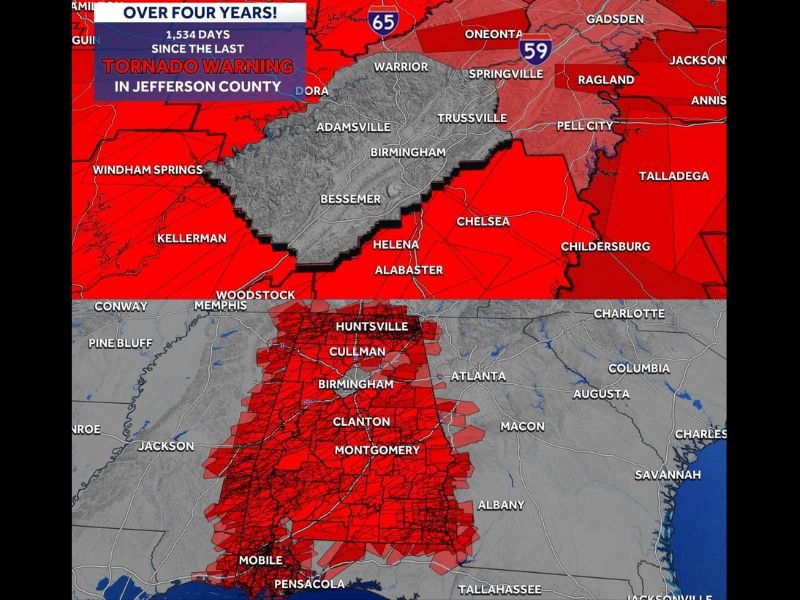
Radar warning maps showing all tornado warnings issued across Alabama since February 18, 2022 painted a striking picture, with red warning polygons blanketing virtually every county across the state including Huntsville, Cullman, Clanton, Montgomery, and Mobile while Jefferson County sat as a notable gray island of warning-free territory surrounded entirely by counties that had received multiple warnings during the same four-year period.
The visual contrast between Jefferson County’s streak and the surrounding warning activity across the rest of Alabama underscored just how improbable the ongoing run of quiet weather had become for the Birmingham metro area.
Streak Creates Forecasting Bias Challenge
With a potentially active weather system on the horizon around May 6, forecasters acknowledged the psychological challenge of blocking out the streak bias when evaluating the incoming data. The law of averages suggested the streak would end eventually, but the specific question of whether any individual system would be the one to break it required objective analysis of each event on its own merits rather than relying on the statistical expectation that the streak must end soon.
For continuing coverage of weather events and critical storm analysis across the United States, visit SaludaStandard-Sentinel.com.