Four Earthquakes Rattle the Caribbean Tectonic Plate Tuesday Night Including a 5.1 and 4.3 Magnitude Strike Near Florida as the Region Turns Highly Active Within Hours
ORLANDO, FL — The Caribbean tectonic plate erupted into a flurry of seismic activity Tuesday night, June 9, with four separate earthquakes striking within a few hours of each other across the Gulf and Caribbean region, including a significant 5.1 magnitude event and a 4.3 magnitude aftershock — prompting close monitoring of further activity near Florida and the broader Gulf Coast.
The Sequence of Events
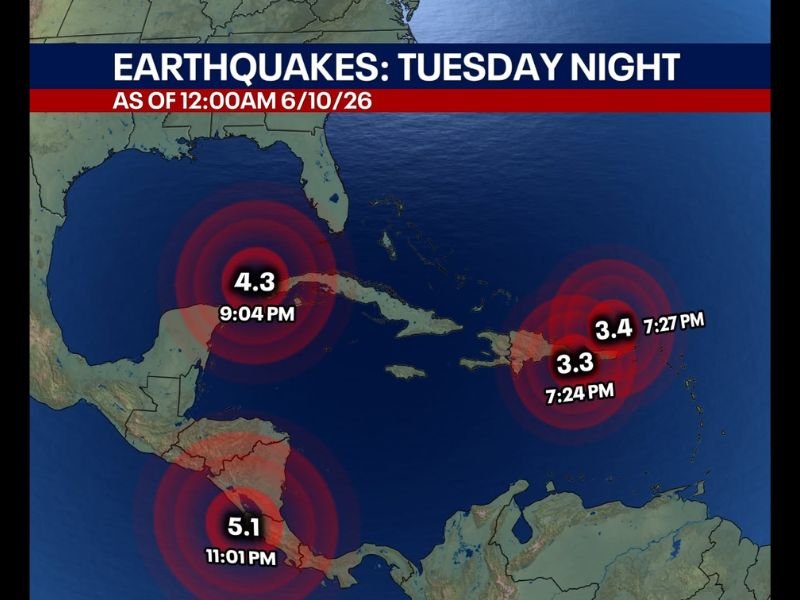
Fox 35 Orlando Storm Team earthquake data as of 12:00 a.m. June 10 documented four distinct seismic events across the Caribbean region Tuesday evening. The sequence began with a pair of earthquakes near Hispaniola in the eastern Caribbean — a 3.3 magnitude strike at 7:24 p.m. followed almost immediately by a 3.4 magnitude event at 7:27 p.m., just three minutes apart in nearly the same location.
Activity then shifted westward, with a powerful 5.1 magnitude earthquake recorded near Central America at 11:01 p.m. — the largest event of the sequence. A 4.3 magnitude aftershock followed in the Gulf region at 9:04 p.m., occurring in nearly the exact location as prior seismic activity, confirming that the Caribbean plate boundary was experiencing repeated stress release across multiple fault segments simultaneously.
What This Means for Florida
The clustering of four earthquakes within a few hours across the Caribbean tectonic plate is an indicator of elevated stress activity along the plate boundary. While the chance of a significant 6.0 or greater magnitude earthquake striking close to Florida within the next few days is estimated at approximately 2%, that probability warrants continued monitoring given the plate’s demonstrated activity level Tuesday night.
Florida does not sit on a major active fault zone, but proximity to Caribbean plate boundary events can produce felt shaking along the peninsula’s southern and Gulf Coast regions depending on earthquake depth and magnitude.
The Caribbean Plate Context
The Caribbean tectonic plate is bounded by the North American plate to the north, the South American plate to the south, and the Cocos and Nazca plates to the west — making it one of the more seismically complex regions in the Western Hemisphere. Periods of clustered seismic activity along its boundaries are not uncommon but always warrant close observation when multiple events occur in rapid succession.
Residents across Florida and the Gulf Coast should remain aware of any updated seismic alerts issued through the United States Geological Survey in the days following this active sequence. For continuing coverage of seismic events and natural hazards across the United States, visit SaludaStandard-Sentinel.com.