USGS Confirms Loud Boom Near Columbia South Carolina Was a Sonic Boom Felt Across 100 Miles With Meteor or Space Debris as Most Likely Source
COLUMBIA, SC — The United States Geological Survey has officially confirmed that a loud boom and shock wave reported by thousands of residents across a wide swath of South Carolina on May 28, 2026 was a sonic boom rather than an earthquake, with the source of the event still unidentified but a meteor or reentering space debris considered the most likely explanation given the enormous geographic area over which the boom was heard and felt.
USGS Rules Out Earthquake and Jet Aircraft
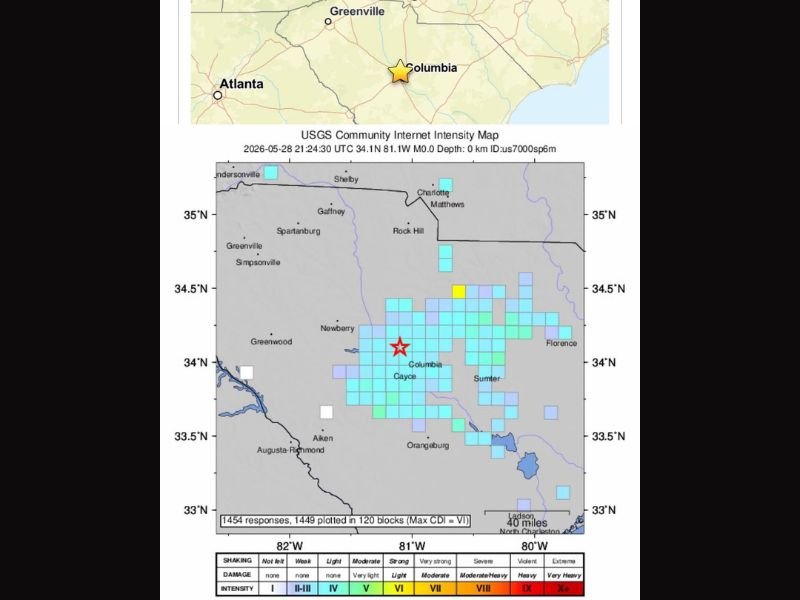
The USGS Community Internet Intensity Map recorded 1,454 responses from residents across the region centered near Columbia and Cayce, South Carolina, with the event logged at coordinates 34.1 degrees North and 81.1 degrees West at a depth of zero kilometers, consistent with an atmospheric rather than seismic origin.
Seismic instrumentation confirmed no earthquake activity associated with the event, eliminating ground-based geological causes entirely. Jet aircraft were also ruled out as a potential source, as a conventional aircraft sonic boom would not propagate over the vast area exceeding 100 miles across which residents clearly heard and physically felt the shock wave during this event.
Meteor or Space Debris Most Probable Cause
With both earthquakes and conventional aircraft eliminated as explanations, scientists and investigators are focusing attention on a meteor or piece of reentering space debris as the most probable source of the powerful sonic boom that rattled windows and startled residents across central South Carolina.
When a meteor or space debris object travels through the Earth’s atmosphere at hypersonic speeds, it generates a shock wave that propagates across an extremely wide geographic footprint at ground level, consistent with the broad distribution of reports stretching from the Columbia metro area outward across communities including Newberry, Sumter, Orangeburg, and extending toward Charlotte and the Augusta-Richmond county region.
Wide Area of Reports Documented
The USGS intensity map shows reported shaking and boom detections spread across a substantial block of central and eastern South Carolina, with the strongest intensity responses concentrated in the Columbia, Cayce, and Newberry corridor nearest the plotted origin point.
Community intensity data reaching a maximum CDI value of VI across portions of the affected zone reflects the significant strength of the shock wave as it reached ground level and propagated outward from its atmospheric source point above the region.
Investigation Continues
The precise origin, trajectory, and nature of the object responsible for the sonic boom remains under investigation, and no official confirmation of a specific meteor or debris reentry event had been issued at the time of this report.
For continuing coverage of significant events and atmospheric phenomena across the United States, visit SaludaStandard-Sentinel.com.