Peak Tornado Season Approaches in May With Greatest Risk Centered Across Central Plains and Dallas Corridor While Chicago, Omaha, and Atlanta Face Greater and Possible Threat Levels
CENTRAL PLAINS — May marks the statistical peak of tornado season across the United States, with the greatest tornado risk concentrated across the central Plains and Dallas corridor as the most potent combination of returning Gulf moisture and retreating winter jet stream energy collides across a historically volatile stretch of the country during the most active month of the severe weather calendar.
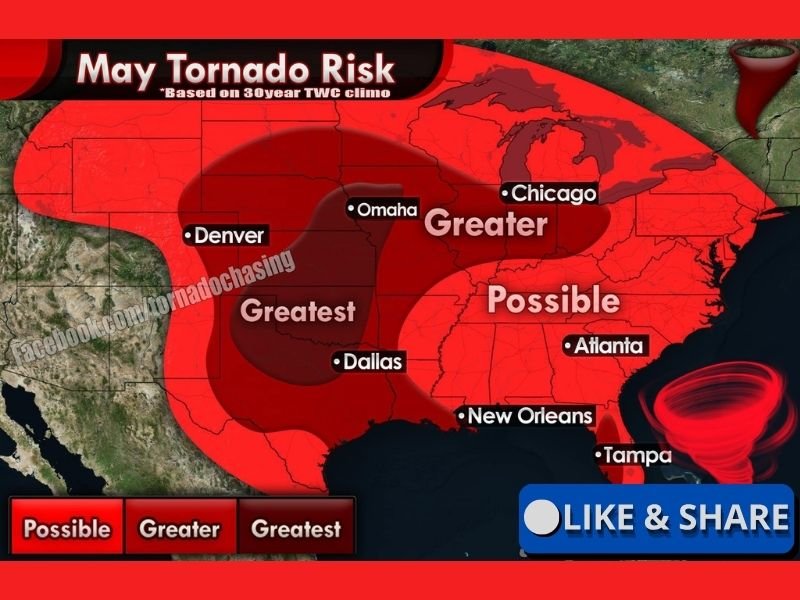
Based on 30-year climatological data, the May tornado risk map showed the greatest threat zone centered across the central Plains region encompassing Denver, Dallas, and the surrounding corridor, with a greater risk zone extending northward through Omaha and Chicago while a possible threat level covered the broader eastern United States including Atlanta, New Orleans, and Tampa.
May Brings the Most Dangerous Atmospheric Combination of the Year
The atmospheric setup that defines May tornado risk is unique among all months of the year. Summertime instability returning northward from the Gulf of Mexico collides with leftover winter jet stream energy still retreating toward Canada, creating the most explosive severe weather environment of the annual cycle across the central United States.
This combination results in virtually the entire country carrying at least some tornado potential during May, though the central Plains consistently emerges as the zone of greatest historical activity based on decades of climatological data compiled across the 30-year record.
Central Plains and Dallas Face Greatest Risk Zone
The darkest and most intense zone on the May tornado risk map, designated as the greatest risk category, was centered across the central Plains stretching from the Denver area eastward through the Dallas corridor. This region historically sees the highest concentration of tornado activity during May, driven by the optimal overlap of wind shear, atmospheric instability, and moisture convergence that defines peak tornado season conditions across the heart of Tornado Alley.
The greatest risk designation reflects decades of historical tornado occurrence data confirming the central Plains and Dallas corridor as the most statistically dangerous region for tornado activity during the month of May.
Greater and Possible Risk Zones Extend Across Broad Areas
The greater risk zone extended northward from the greatest risk core through Omaha and Chicago, reflecting the increasing tornado activity that historically develops across the northern Plains and Midwest as May progresses. The Midwest had already seen an extraordinarily active severe weather season through 2026, making the climatological peak season arrival a particularly significant development for communities across that region.
A possible risk designation covered the broader eastern United States including Atlanta, New Orleans, and Tampa, confirming that no region east of the Rockies was entirely free from tornado potential during the statistical peak of the season.
Mid to Late May Represents Peak Volatility Window
While the first ten days of May historically tend toward quieter conditions, the middle and later portions of the month are well established as the peak volatility window across the central Plains and Midwest. The late May timeframe in particular represented the period when atmospheric conditions most consistently aligned to produce significant and widespread tornado outbreaks across the greatest and greater risk zones identified on the May climatological tornado risk map.
For continuing coverage of severe weather events and critical storm analysis across the United States, visit SaludaStandard-Sentinel.com.