Rare G4–G5 Solar Storm Watch Brings Northern Lights Viewing Potential to Texas, Louisiana, Mississippi, Alabama, Georgia, Florida, and the Carolinas Tonight
UNITED STATES — A rare and powerful space weather event is unfolding tonight as forecasters warn that a strong solar storm could push the Northern Lights far south of their usual range, potentially reaching portions of the Gulf Coast and the Southeast under the right conditions.
The Space Weather Prediction Center has issued a G4–G5 Solar Storm Watch, triggered by a powerful X-class solar flare and Earth-directed coronal mass ejection (CME) racing toward the planet. If the storm arrives during nighttime hours and aligns favorably with Earth’s magnetic field, auroral activity could become visible across several southern U.S. states — an uncommon and noteworthy event.
What Is Driving This Rare Solar Storm Event
The current setup stems from an intense X-class solar flare, the strongest category of solar eruptions, which released a fast-moving CME directly toward Earth. These charged particles interact with Earth’s magnetosphere, potentially triggering strong geomagnetic storms capable of expanding auroral visibility far south of normal.
G4 and G5 storms are rare, occurring only a handful of times per solar cycle. When they do occur, they can produce widespread auroras, disrupt radio communications, and impact satellites and power grids.
States With Potential Aurora Visibility Tonight
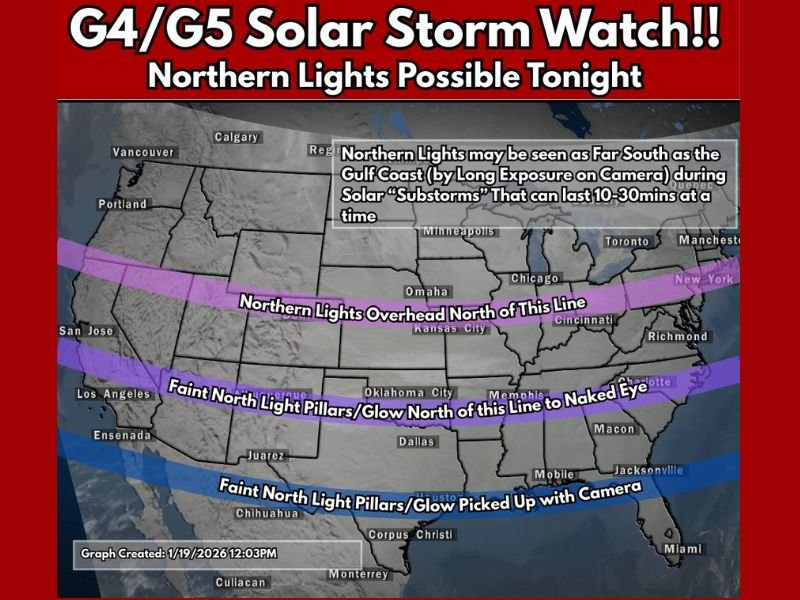
Based on the projected strength and trajectory of the storm, auroral viewing potential extends well beyond the northern tier of the United States.
Possible viewing zones include:
- Texas (especially North and Central Texas, camera-assisted viewing)
- Louisiana
- Mississippi
- Alabama
- Georgia
- South Carolina
- North Carolina
- Tennessee
- Arkansas
- Oklahoma
- Virginia
In these southern states, auroras may appear as faint pillars, glows, or bands low on the northern horizon and may be best captured using long-exposure photography rather than the naked eye.
Best Time and Viewing Conditions for the Northern Lights
Timing remains one of the biggest uncertainties with solar storms. Current projections suggest the most favorable window is late tonight into the overnight hours, when Earth’s rotation places North America in optimal alignment.
For the best chance to see or capture the aurora:
- Get away from city lights
- Face north toward the horizon
- Look for clear skies
- Use a camera with night mode or long exposure
- Be patient — auroral “substorms” can last 10 to 30 minutes at a time
Even brief breaks in cloud cover could be enough to reveal activity.
What Makes This Event So Unusual for the South
Auroras are typically confined to northern latitudes near Canada and Alaska. For them to reach states like Texas, Louisiana, Alabama, and Georgia, the geomagnetic storm must be exceptionally strong — which is why this event has drawn so much attention.
While not everyone will see vivid colors overhead, southern aurora events are often subtle but still historic, especially when captured on camera.
Additional Impacts From a G4–G5 Geomagnetic Storm
Beyond auroras, strong solar storms can also cause:
- Shortwave radio disruptions
- GPS signal interference
- Increased satellite drag
- Minor power grid fluctuations at high latitudes
No widespread infrastructure impacts are expected at this time, but operators remain on alert due to the storm’s intensity.
Bottom Line
A rare G4–G5 solar storm could bring the Northern Lights into view across parts of Texas, Louisiana, Mississippi, Alabama, Georgia, Florida, and the Carolinas tonight, especially through cameras and long-exposure photography. While visibility depends heavily on timing and cloud cover, the setup is strong enough to warrant attention and preparation.
This is not a guarantee — but it is a legitimate, high-end opportunity for an unusual southern aurora display. Stay tuned to SaludaStandard-Sentinel.com for continued space weather updates, viewing tips, and overnight developments as this rare solar storm unfolds.