Illinois, Missouri, Indiana and Kentucky Face Extended Late Freeze Threat as Chicago, Rockford and Peoria Near Final Frost Dates Into Late April
ILLINOIS — Residents across Illinois and neighboring states are being warned not to rush into spring planting just yet, as new data shows the average last freeze could stretch into late April across much of the region.
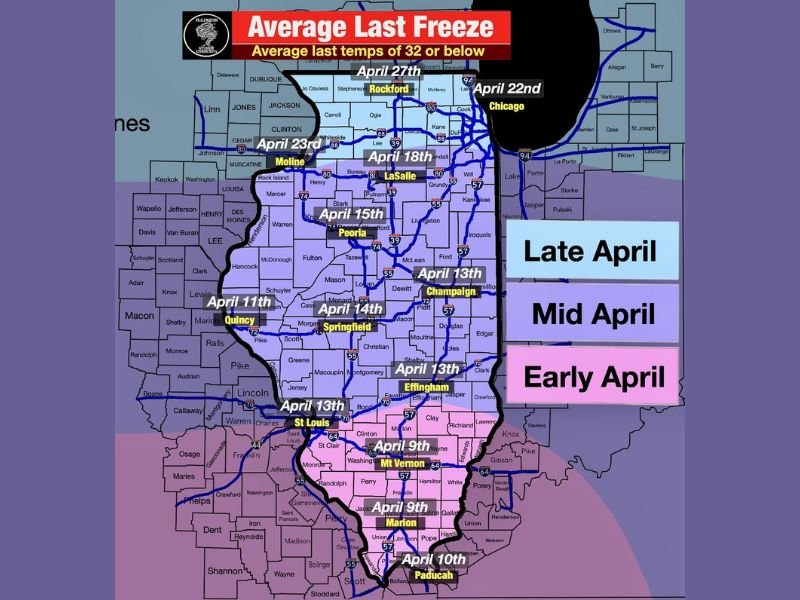
The latest freeze timeline map highlights a wide range of final frost dates, with northern Illinois areas like Chicago typically seeing their last freeze around April 22, while central and southern parts of the state could experience freezing temperatures earlier—but still into mid-April.
Late Season Freeze Risk Still Looms Across the Region
Despite recent warmer temperatures, the data suggests that late-season cold snaps remain a real possibility across Illinois, Missouri, Indiana, and Kentucky. Northern sections of Illinois, including Rockford, may not fully clear freeze risks until around April 27, marking one of the latest timelines in the region.
Meanwhile, cities like Moline and Chicago fall slightly earlier in the window, with expected last freeze dates around April 23 and April 22 respectively. However, experts caution that these are averages, meaning unexpected cold surges could still occur beyond these dates.
This lingering frost risk is especially important for gardeners and farmers, many of whom may be tempted to begin planting after recent mild conditions.
Central and Southern Illinois See Earlier Dates but Continued Uncertainty
In central Illinois, areas such as Peoria and Springfield typically see their final freeze between April 14 and April 15. Further south, locations like Effingham and Champaign fall closer to April 13, while southern Illinois cities like Marion and Mount Vernon may experience their last freeze as early as April 9.
Even with these earlier dates, the broader pattern shows that the entire region remains vulnerable to temperature drops well into mid-April. This creates a staggered risk zone, where planting decisions must be carefully timed based on local conditions rather than statewide assumptions.
Missouri, particularly near St. Louis, aligns closely with southern Illinois, with average last freeze dates around April 13, reinforcing the regional nature of this late-season cold threat.
Why Experts Recommend Waiting Until Mid-May
Weather guidance suggests that beyond these average freeze dates, there is still potential for unusual cold spells into late April and even early May. This has led to a strong recommendation for residents to delay planting sensitive vegetation until after Mother’s Day.
The reasoning is simple: even a brief overnight freeze can damage or destroy early crops and flowers, undoing weeks of preparation. By waiting until mid-May, the risk of frost drops significantly across Illinois and neighboring states.
This approach is especially critical for those in northern Illinois, where the freeze window extends longest and variability remains highest.
A Gradual Transition Into Stable Spring Weather
While the freeze risk does not disappear overnight, the overall trend still points toward a gradual warming pattern. Southern parts of the region will transition into stable spring conditions first, followed by central and northern zones.
However, the transition is uneven, and residents should continue monitoring local forecasts closely. The map serves as a reminder that spring weather in the Midwest often arrives in stages, not all at once.
For now, patience remains key as the region navigates the final stretch of winter’s lingering grip. If you’re planning to start your garden or have already noticed fluctuating temperatures in your area, share your experience and join the conversation at SaludaStandard-Sentinel.com.