Alabama Tornado Risk Peaks on April 27 With November Secondary Surge as New Data Highlights Year-Round Threat
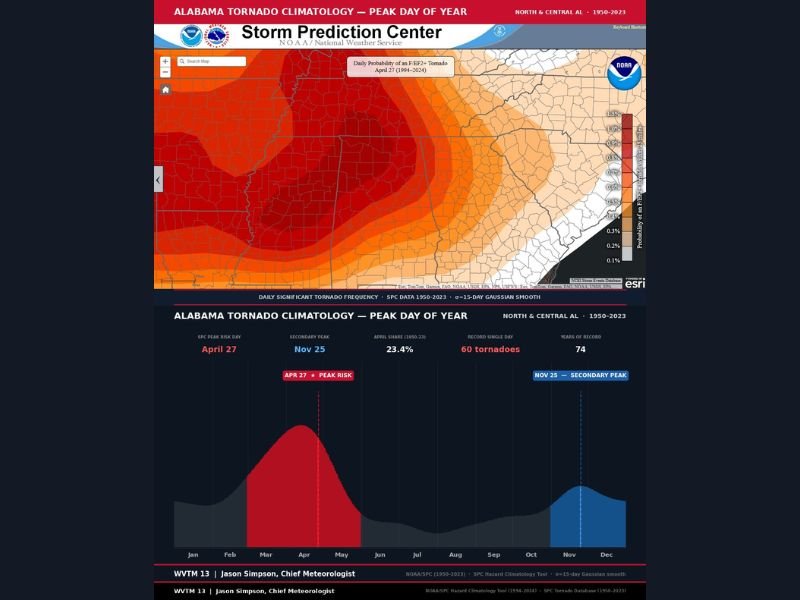
ALABAMA — New climatology data is reshaping how residents understand tornado season across the state, revealing that the highest risk is not spread across months but instead peaks sharply on a specific day — April 27 — with a secondary spike later in the year.
April 27 Identified as Alabama’s Peak Tornado Risk Day
Recent analysis of long-term severe weather data shows that the climatological peak for tornado activity in North and Central Alabama occurs on April 27. This finding stands out because it pinpoints a single day rather than a broad seasonal window.
Historical records indicate that late April consistently delivers the highest frequency of tornado activity, reinforcing what many meteorologists have observed anecdotally for years — that spring storms reach their most dangerous phase toward the end of April.
The data also shows that April alone accounts for a significant portion of annual tornado activity, emphasizing the importance of heightened awareness during this period.
November Emerges as a Secondary Tornado Peak
While spring remains the most active period, the data also highlights a second, lesser-known peak in late fall. Around late November, tornado frequency rises again, creating a secondary season that often catches residents off guard.
This fall resurgence is tied to shifting atmospheric patterns that can mirror spring-like conditions, allowing severe storms to develop even as temperatures cool.
Data Shows Tornado Season Never Truly Ends
One of the most important takeaways from the updated analysis is that tornado season in Alabama is not confined to a traditional timeframe. Instead, it is a year-round risk that intensifies during specific periods.
The data underscores that while spring and fall are the most active, tornadoes can and do occur outside those peaks. This reinforces the need for continuous preparedness rather than seasonal awareness alone.
Why Late April Stands Out in Historical Trends
The sharp peak in late April is linked to a combination of atmospheric ingredients that align more frequently during this time. Warmer air, increasing moisture, and stronger jet stream dynamics all contribute to an environment favorable for severe storm development.
Historical comparisons also show that even in years with fewer tornadoes overall, late April often still produces significant events. This consistency is what makes April 27 stand out as a key date in Alabama’s severe weather calendar.
Experts Emphasize Awareness Over Fear
Officials and weather experts stress that this data is not meant to alarm residents but to inform them. Understanding when risk is historically highest allows communities to better prepare and respond when severe weather threatens.
Even during quieter years, the underlying risk remains. The data serves as a reminder that preparedness — including having a warning system and a safety plan — is critical regardless of recent storm activity.
A Reminder for Residents Across Alabama
As Alabama moves deeper into spring, the findings highlight the importance of staying weather-aware, particularly as late April approaches. With another peak in November, the message is clear: tornado preparedness is not seasonal — it is ongoing.
Residents across the state are encouraged to review their severe weather plans and ensure they have multiple ways to receive alerts. Have thoughts on Alabama’s tornado trends or experiences during past severe weather events? Share your perspective with the community at SaludaStandard-Sentinel.com.