Rare January 3 Alignment Brings Supermoon, Earth’s Closest Solar Approach, and Quadrantid Meteor Peak on the Same Day
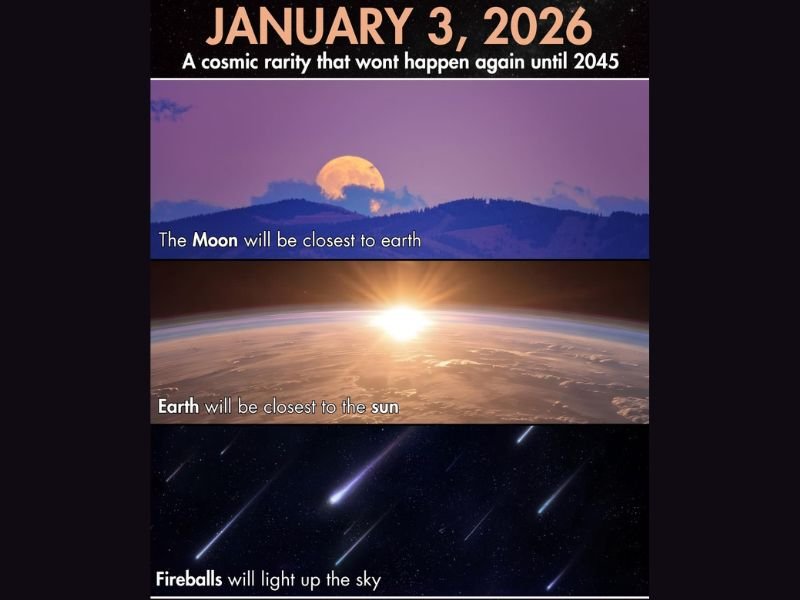
UNITED STATES — Skywatchers across the Northern Hemisphere will experience a rare astronomical alignment on January 3, as three major cosmic events occur within the same 24-hour period: the year’s first full supermoon, Earth’s closest annual point to the Sun, and the peak of the Quadrantid meteor shower.
While each event happens regularly on its own, their close alignment on the same day is unusual and will not repeat in this configuration again until 2045, according to astronomy observers.
Supermoon Marks the Closest Full Moon of the Year
January’s full moon, often referred to as the Wolf Moon, coincides with the Moon reaching perigee, its closest point to Earth during this orbit. This combination creates a supermoon, which can appear slightly larger and brighter than an average full moon. The enhanced brightness can sharpen nighttime shadows and brighten the sky, particularly in rural areas with limited light pollution.
Earth Reaches Perihelion During Northern Hemisphere Winter
On the same day, Earth reaches perihelion, its closest point to the Sun for the entire year. Despite winter conditions across the Northern Hemisphere, Earth is actually about 3 million miles closer to the Sun than it is during July. This is due to the elliptical shape of Earth’s orbit. At perihelion, Earth also travels at its fastest orbital speed, moving around the Sun at nearly 67,000 miles per hour.
Quadrantid Meteor Shower Peaks Under Bright Moonlight
January 3 also marks the peak of the Quadrantid meteor shower, caused as Earth passes through debris left behind by an ancient asteroid. Under ideal dark skies, the Quadrantids can produce 40 to 100 meteors per hour.
However, this year’s bright supermoon is expected to significantly reduce visibility. Most observers may only see a handful of meteors per hour, though the Quadrantids are known for producing bright fireballs, which can still be visible despite moonlight.
Why the Alignment Is Unusual but Not Dangerous
While the timing of these events is rare, astronomers stress that there is no added physical impact on Earth. The alignment does not influence weather, earthquakes, or tides beyond normal seasonal variations. The significance of January 3 lies in observation and timing, not risk.
Best Viewing Expectations
Clear skies will be required to observe any portion of the event. The supermoon will be visible throughout the night, while the best chance to spot Quadrantid meteors typically occurs in the early morning hours, away from city lights. Even limited visibility offers a chance to witness a notable moment in the 2026 astronomical calendar.
If skies are clear where you live, taking a moment to look up could offer a rare view of multiple celestial events unfolding at once. Share your observations and continue following science and sky coverage at SaludaStandard-Sentinel.com.