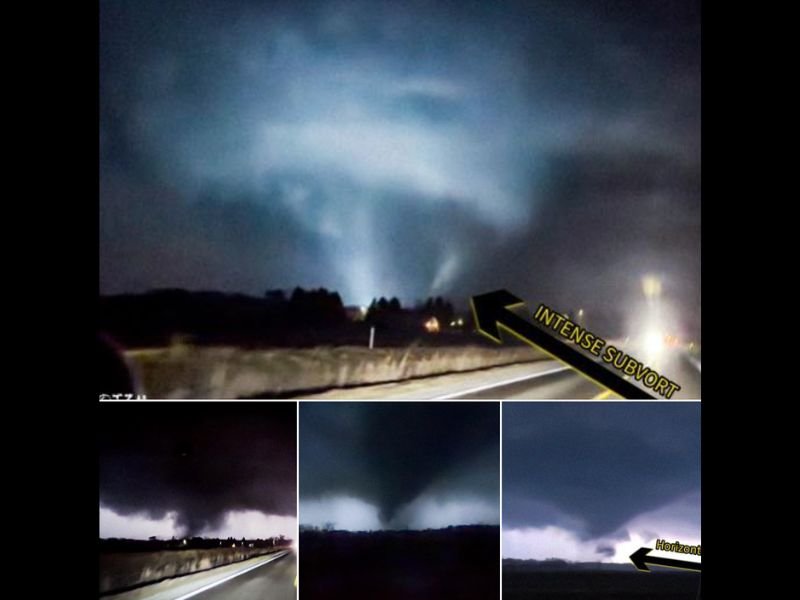
Violent Wheatfield, Indiana Tornado Shows Powerful Suction Vortices and Roaring Winds During Intense Overnight Storm
WHEATFIELD, INDIANA — A powerful overnight tornado near Wheatfield left storm observers stunned after displaying violent characteristics rarely seen in nighttime storms across northern Indiana.
Meteorologists and storm trackers say the tornado intensified rapidly during its life cycle, producing dramatic suction vortices and strong horizontal wind circulations that signaled a highly dangerous storm structure. Despite occurring after dark, the tornado appeared to exhibit features that could place it among the more notable tornado events recorded in the region in recent years.
Witnesses also reported hearing a loud, continuous roar as the tornado moved across the landscape, a sound commonly associated with powerful tornadoes.
Tornado Exhibited Violent Structural Features
Storm observers monitoring the event reported that the tornado showed several indicators of intense strength throughout its life cycle.
Among the most striking features were multiple suction vortices rotating around the main tornado funnel. These smaller but extremely powerful rotating columns can dramatically increase localized wind speeds and cause severe damage within narrow paths.
Observers also noted horizontal vortices forming within the storm’s structure. These complex wind patterns can appear when a tornado becomes highly organized and powerful within a rotating supercell thunderstorm. These features combined to produce a visually dramatic storm that appeared capable of intense destruction along its path.
Nighttime Tornado Made the Storm Even More Dangerous
Because the tornado developed after dark, visibility conditions made the situation even more dangerous for residents in the area.
Nighttime tornadoes are often considered more hazardous because they are harder to see approaching. Many residents may not recognize the threat until the storm is already nearby.
Storm trackers following the system described the tornado as a large, rotating structure that appeared partially illuminated by lightning flashes as it moved across the countryside. Despite limited visibility, the storm’s powerful structure remained visible enough for observers to document its dramatic appearance.
Audible Roar Reported by Witnesses
In addition to the tornado’s visual features, witnesses described hearing a loud roar as the storm passed through the area.
The roaring sound produced by strong tornadoes often comes from the combination of violent winds, flying debris, and rapidly rotating air within the vortex.
People who have experienced major tornadoes frequently compare the sound to a freight train or jet engine passing nearby. Reports from the Wheatfield area suggest that the tornado produced a similar sound as it intensified and moved through the region.
Storm Part of Active Early March Severe Weather Pattern
Meteorologists say the tornado is part of a larger severe weather pattern that has been developing across parts of the Midwest during the early days of March. As warmer air moves northward and interacts with colder air masses across the region, the atmosphere can become favorable for powerful thunderstorms capable of producing tornadoes and damaging winds.
These conditions often appear during seasonal transitions when strong temperature contrasts help fuel intense storm systems. Weather experts continue to analyze radar data and storm reports to better understand the tornado’s strength and path as surveys continue in the affected area. Readers who experienced severe weather in their communities can share updates and follow ongoing storm coverage at SaludaStandard-Sentinel.com.