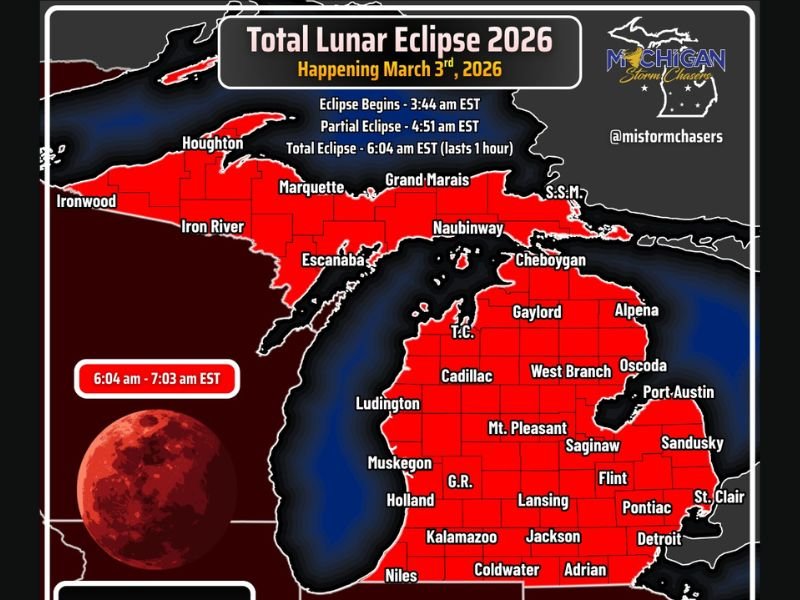
Michigan to Witness Rare Total Lunar Eclipse on March 3, 2026 as “Blood Moon” Glows Red Before Dawn
MICHIGAN — Early on the morning of March 3, 2026, skywatchers across the state will have the chance to witness a rare total lunar eclipse, as the moon passes directly behind the Earth and takes on a deep red glow.
Astronomers explain that this celestial event occurs when Earth moves between the sun and the moon, casting its shadow — known as the umbra — across the lunar surface. As shorter wavelengths of light scatter away in Earth’s atmosphere, the longer, warmer wavelengths bend through and illuminate the moon in a reddish hue, creating what many call a “blood moon.”
Eclipse Timeline: When to Watch
According to the provided timing details, the eclipse will unfold in stages during the early morning hours.
The eclipse begins at 3:44 a.m. EST, followed by the partial eclipse at 4:51 a.m. EST. Totality — the most dramatic phase when the moon appears fully red — begins at 6:04 a.m. EST and lasts approximately one hour, ending around 7:03 a.m. EST.
Residents are encouraged to set alarms early and step outside before sunrise for the best viewing opportunity. Clear skies will be essential, and forecasters are expected to release more specific cloud cover projections as March 3 approaches.
A Rare Opportunity for the United States
This event carries additional significance because it will be the last total lunar eclipse visible across the United States until 2028.
Unlike solar eclipses, lunar eclipses are safe to view with the naked eye. No special glasses or equipment are required, though binoculars or telescopes can enhance the experience.
The alignment needed for a total lunar eclipse does not happen frequently. When the moon fully enters Earth’s shadow, the resulting deep crimson glow often creates an eerie yet spectacular sight in the pre-dawn sky.
No Superstitions — Just Science
Despite long-standing folklore linking eclipses to superstition, experts emphasize that this event is purely astronomical. Interestingly, this total lunar eclipse will occur 10 days before Friday the 13th — not on it.
The red coloration of the moon is simply the result of sunlight filtering through Earth’s atmosphere, similar to the effect that makes sunsets appear red or orange.
Plan Ahead for the Best View
Because totality begins just after 6 a.m. EST, viewers should find an open area with a clear western horizon before sunrise begins to brighten the sky.
Weather conditions will play a critical role. Cloud cover could obscure visibility, so residents are advised to monitor updated forecasts as the date draws closer.
For those who miss this event, the wait will be long. The next opportunity for a total lunar eclipse visible across the U.S. will not come until 2028.
Will you be waking up early to see the moon turn red? Share your eclipse plans and photos with us at SaludaStandard-Sentinel.com.