Long-Range Model Dispute Shows No Ensemble Support for Extreme Cold Outbreak Across Texas, Oklahoma, Kansas, Missouri, Arkansas, Illinois, Indiana, Ohio, and the Northeast Ahead of December 22
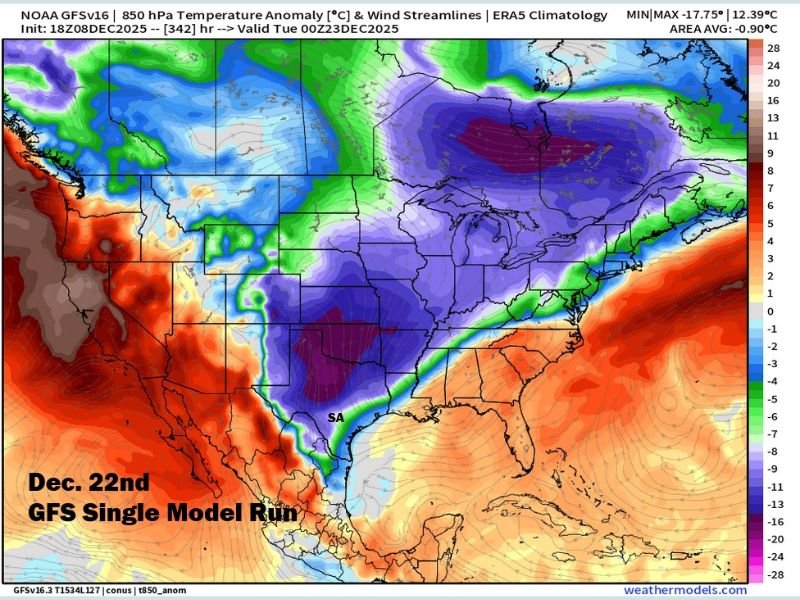
UNITED STATES — Meteorologists are urging caution after viral social media posts began circulating forecasts showing a potential major Arctic outbreak across Texas, Oklahoma, Kansas, Missouri, Arkansas, Illinois, Indiana, Ohio, and parts of the Northeast around December 22. Experts say these claims rely on a single long-range model run, with no ensemble support, meaning the scenario lacks scientific confidence.
Viral Forecast Claims Stem From a Single GFS Run With No Supporting Ensemble Data
The discussion centers on a 300+ hour GFS model run, which depicted extreme cold plunging deep into the central and eastern United States. However, meteorologists warn that one operational model run should not be interpreted as a reliable forecast when ensembles — the scientific method for confirming trends — show no similar outcome.
The GEFS ensemble, composed of 30 model members, represents different atmospheric scenarios to test forecast confidence. According to the data shown, none of the 30 ensemble members reproduced the dramatic cold plunge displayed in the viral GFS run.
Without ensemble agreement, experts say the advertised cold blast is not supported by real forecast probability.
Ensemble Maps Suggest a Much Milder Pattern Across the Central and Eastern United States
The ensemble mean maps show significantly warmer temperature anomalies across:
- Texas and Oklahoma
- Kansas and Missouri
- Arkansas and Illinois
- Indiana, Ohio, and the Mid-Atlantic
Meanwhile, the coldest anomalies in the ensemble remain concentrated over Canada, with only minor extensions into portions of the Upper Midwest.
This sharply contradicts the viral cold depiction, reinforcing meteorologists’ message that long-range deterministic model runs are not reliable on their own.
Experts Warn Against Social Media “Cherry-Picking” of Long-Range Model Images
Meteorologists cited concerns about popular social media pages and groups that routinely cherry-pick extreme model frames—often 10–14 days out—to generate engagement.
Experts emphasize:
- Ensemble support is required to boost confidence in long-range forecasts
- Single cold or warm model frames must not be treated as official guidance
- Forecasts 300 hours out can change dramatically in just one or two model cycles
While long-range models are useful for spotting potential trends, they are not designed to be interpreted as precise outcomes.
Forecasters Say It Is Too Early to Predict December 22 Weather With Confidence
Meteorologists note that while changes may still occur as new data arrives, the lack of ensemble agreement makes the currently advertised extreme cold scenario unlikely.
Experts advise the public not to “bet the ranch” on a major Arctic outbreak around December 22 based on the current data, stressing that confidence remains low and more reliable guidance will emerge only as the date approaches.
Forecasters will continue monitoring trends in both operational and ensemble models through the coming week.
Do viral weather posts influence how you prepare for winter? Share your thoughts with us at SaludaStandard-Sentinel.com.