Illinois Weather Shock: Massive 6.14-Inch Hailstone in Kankakee Could Set New State Record After Violent Storm
ILLINOIS — An extraordinary hailstone discovered after a powerful storm in Kankakee may soon rewrite Illinois weather history. Meteorologists say a hailstone measuring 6.14 inches in diameter fell during an intense storm on March 10, potentially becoming the largest hailstone ever officially recorded in the state.
The massive piece of ice was found following a violent storm system that moved through the area and reportedly included tornado activity. Weather experts say the hailstone’s size is remarkable even by severe weather standards and is now undergoing the certification process for a possible state record.
Giant Hailstone Measured at More Than Six Inches Wide
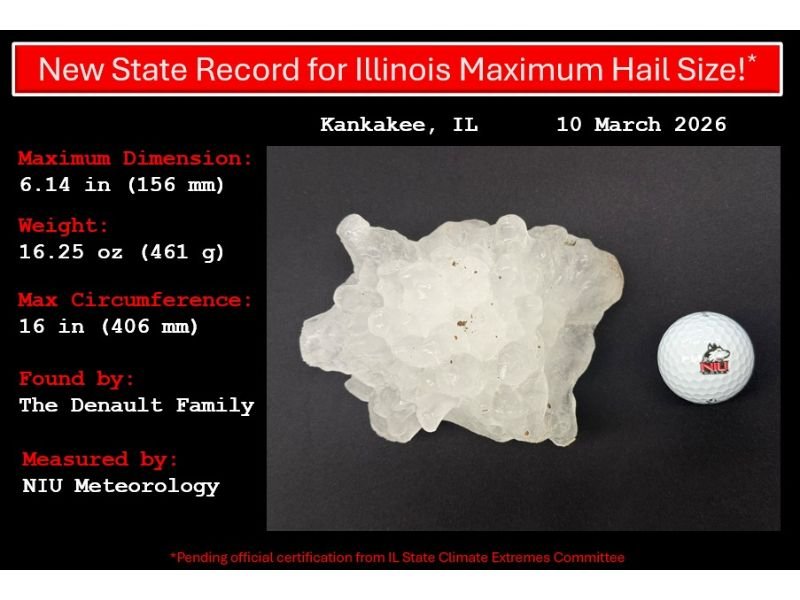
The hailstone recovered in Kankakee, Illinois, measured 6.14 inches in maximum diameter, according to meteorologists who examined the specimen. That measurement is equivalent to roughly 156 millimeters, making the ice chunk significantly larger than a typical golf ball-sized hailstone often seen in strong thunderstorms.
Researchers also recorded the hailstone’s weight at approximately 16.25 ounces, or about 461 grams. In addition, its maximum circumference measured roughly 16 inches, highlighting just how unusually large the hail formation was. For comparison, many severe thunderstorms produce hail between one and two inches in diameter, meaning the Kankakee hailstone was several times larger than what most storms generate.
Discovery Reported by Local Family After Severe Storm
The enormous hailstone was discovered by the Denault family, who recovered the ice after the storm passed through the area. Once reported, meteorologists quickly began evaluating the hailstone to determine its exact dimensions and verify the measurement.
Experts from Northern Illinois University (NIU) Meteorology conducted the official measurements and documentation of the hailstone. Their analysis confirmed the exceptional size of the specimen and triggered a review process to determine whether the hailstone qualifies as a new state record.
At this time, the measurement remains pending official certification from the Illinois State Climate Extremes Committee, the body responsible for verifying extreme weather records in the state.
Storm System Also Produced Tornado Activity
The storm that generated the giant hailstone was not just notable for its hail. Reports indicate that an intense tornado also struck the Kankakee area during the same weather event.
Strong rotating thunderstorms can create the ideal environment for extremely large hail. Powerful updrafts inside these storms repeatedly lift hailstones high into freezing layers of the atmosphere, allowing them to accumulate additional layers of ice before eventually falling to the ground. In especially strong storms, hailstones can grow to extraordinary sizes before gravity finally overcomes the storm’s updrafts.
Rare Weather Event Highlights Storm Strength
Meteorologists say hailstones exceeding six inches in diameter are extremely rare and require very specific atmospheric conditions to form. Such storms typically feature exceptionally strong updrafts capable of suspending hailstones in the storm cloud for extended periods.
As the hailstone moves up and down within the thunderstorm, it collects layers of ice that gradually increase its size until it becomes too heavy to remain airborne. Events like the one in Kankakee serve as a reminder of how powerful severe thunderstorms can become, especially during active weather patterns across the Midwest.
Record Certification Process Now Underway
The Illinois State Climate Extremes Committee will review the measurements and documentation before determining whether the hailstone officially becomes the new state record for maximum hail size.
If certified, the 6.14-inch hailstone would represent one of the most significant weather records in Illinois history. Weather experts say the verification process may take time, but the data collected so far strongly suggests the hailstone could indeed set a new benchmark for extreme hail events in the state.
Readers who experienced the powerful storms across Illinois or nearby states can share their weather photos and storm reports with the community by visiting SaludaStandard-Sentinel.com.