Four Earthquakes Rattle Summerville–Centerville Area in One Week, Renewing Focus on South Carolina’s Seismic Hot Spot
SOUTH CAROLINA — A series of small earthquakes near the Summerville and Centerville area has caught the attention of residents and geologists alike, after four tremors were recorded within just seven days in the Charleston region.
According to the data shown, the recent earthquakes include:
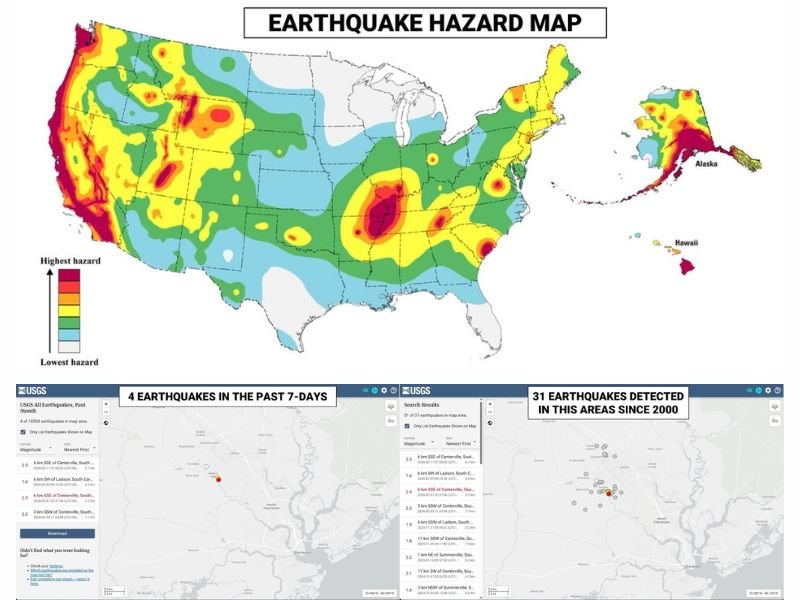
- February 11: Magnitude 2.5 (6 km SSE of Centerville)
- February 9: Magnitude 1.6 (6 km SW of Ladson)
- February 7: Magnitude 2.9 (6 km SSE of Centerville)
- February 3: Magnitude 2.3 (3 km SSW of Centerville)
While none of these earthquakes were strong enough to cause structural damage, several were reportedly felt by residents, especially during quiet evening or early morning hours.
A Familiar Seismic “Bullseye” in the Lowcountry
The activity is centered in what’s known as the Middleton Place–Summerville Seismic Zone, an area long recognized as one of South Carolina’s most active earthquake regions. Hazard maps show this section of the Lowcountry as a distinct seismic “bullseye,” reflecting a higher historical probability of ground movement compared to much of the Southeast.
Though many people associate earthquakes with California or Alaska, South Carolina has a notable seismic history. The state experienced one of the most powerful earthquakes ever recorded on the East Coast in 1886, when a magnitude 7.0 quake struck Charleston.
More recently, records indicate 31 earthquakes have been detected in this specific Summerville–Centerville area since 2000. That context is important: while four quakes in a single week may seem alarming, clusters like this are known as a “swarm” — a short-term burst of minor seismic events occurring in the same area.
What Is an Earthquake Swarm?
An earthquake swarm differs from the typical “mainshock-aftershock” pattern. Instead of one large quake followed by smaller ones, a swarm consists of multiple quakes of similar magnitude occurring over days or weeks.
Experts say most swarms in South Carolina are relatively weak and do not escalate into major seismic events. Still, the frequency of activity this week has prompted renewed public curiosity about what lies beneath the Lowcountry.
Should Residents Be Concerned?
At this time, there is no indication of a larger earthquake imminent, and all four recent tremors fall into the light magnitude category. Events between 1.0 and 3.0 are generally too small to cause damage but can be felt indoors.
However, officials and scientists continue monitoring the region closely. Even small earthquakes serve as reminders that the ground beneath South Carolina is not entirely quiet.
While hurricanes and severe storms dominate weather headlines in the Carolinas, seismic activity is also part of the state’s geological reality. Residents who felt shaking are encouraged to report their experience through official earthquake reporting systems, which helps improve tracking and research.
For continued updates on South Carolina seismic activity and other developing local stories, stay connected with SaludaStandard-Sentinel.com — your source for reliable regional news and alerts.