Colder Weather Pattern Likely for New Year’s Week Across Texas, Oklahoma, Kansas, Colorado, New Mexico, and the Central United States
UNITED STATES — Forecast models are increasingly signaling a notable shift toward a colder weather pattern as the nation heads into New Year’s Week, bringing an end to the widespread warmth that has dominated much of December across the central and southern United States.
Models Show Stronger Support for a Colder Pattern
Meteorologists analyzing ensemble guidance say multiple long-range model runs now consistently support a broader push of colder air dipping into states including Texas, Oklahoma, Kansas, Colorado, and New Mexico, with the potential to expand farther east if the pattern continues to organize.
While long-range projections can be uncertain beyond seven days, the consistency across ensemble members is a key indicator that the colder pattern is becoming more probable.
Uncertainty Remains in Precipitation Amounts
Despite growing confidence in the colder temperatures, forecasts remain highly uncertain regarding potential precipitation. Models are still struggling to resolve:
- How far south the cold air will push
- Whether storm energy will align with the colder air
- The timing and formation of any winter precipitation
At this stage, meteorologists stress that no exact snowfall amounts, rain-to-snow transitions, or specific timing can be determined.
More clarity is expected once the model spread tightens and conflicting solutions begin to resolve.
Warmth Lingers in the Southeast as Cold Builds to the West
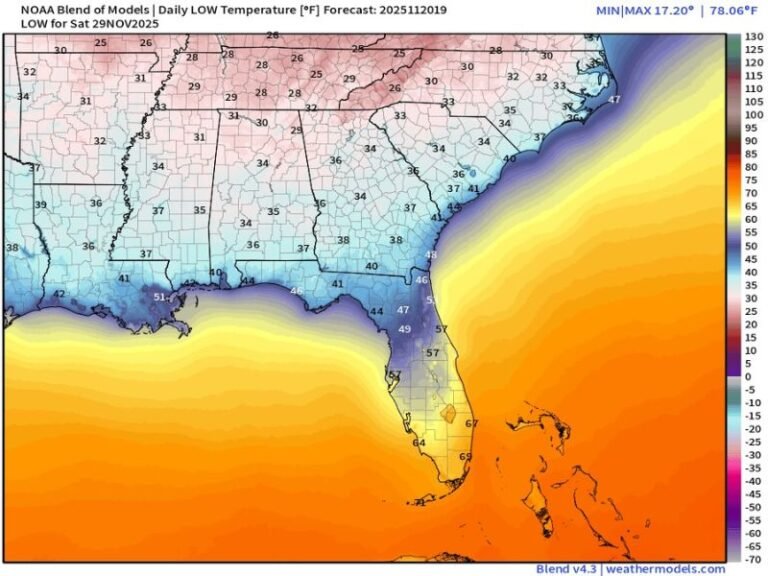
Current temperature trends show the warmth holding firm across the Southeast and Gulf Coast, while colder air begins to seep southward through the Rockies and Central Plains.
This creates a sharp contrast across the nation:
- Colder conditions building in the West, Rockies, and Central Plains
- Warmer air persisting from the Deep South through the Southeast
If the cold air deepens and shifts eastward, more states could see a noticeable change heading into the first days of January.
What Residents Should Expect for Now
Forecasters emphasize patience as the models continue to evolve through the holiday weekend. For now, residents across the central United States should expect:
- Increasing confidence in colder-than-normal temperatures after New Year’s
- Ongoing uncertainty regarding any snow, ice, or mixed precipitation
- More detailed predictions once the atmospheric pattern stops “bickering,” as forecasters describe the fluctuating model behavior
Updates will become more reliable as the system draws closer. For continuing coverage and updated forecasts throughout the holiday and New Year’s period, visit SaludaStandard-Sentinel.com.