Alaska–Canada Border Records 812 Earthquakes In 30 Days As Activity Tightens Around Mount Logan
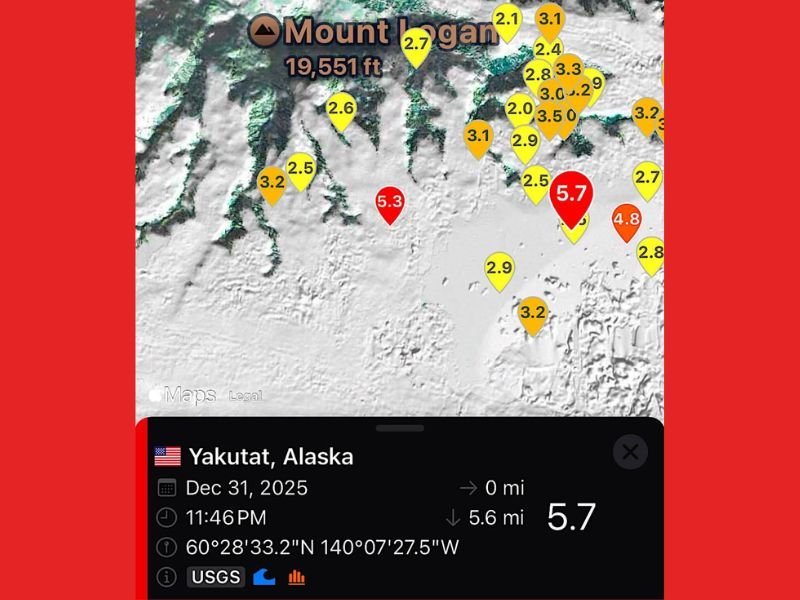
ALASKA — More than 812 earthquakes have struck the Alaska–Canada border region in the past 30 days, with nearly all activity clustering around Mount Logan, the second-highest peak in North America at 19,551 feet. The unusual volume and tight grouping of quakes have drawn scientific attention due to repeated seismic stress in a single high-elevation zone.
Rapid Surge in Earthquakes Around Mount Logan
The recent swarm is not scattered or typical of background seismic noise. Instead, quakes have been concentrated in a tightening pattern, suggesting that the ground beneath the glaciated Saint Elias Mountains is undergoing noticeable stress. Many of these events have been shallow, which makes them more significant even in remote areas.
Two Stronger Quakes Signal Rising Energy
On December 31, Yakutat, Alaska recorded two larger earthquakes just eight minutes apart — a magnitude 5.3 followed by a magnitude 5.7. Both occurred in the same active zone and at shallow depths. While no damage was reported, the timing and strength raise questions about whether the region is entering a more active seismic phase.
What Scientists Are Monitoring
Repeated shallow earthquakes striking the same location over a short period prompt several scientific considerations:
• Whether tectonic stress is redistributing beneath the Saint Elias range
• Whether glacial mass changes are shifting pressure along fault lines
• Whether this is the beginning of a long-duration seismic cycle, rather than isolated activity
Researchers emphasize that there are no definitive conclusions yet, but the behavior warrants close monitoring.
Unusual Activity Continues With No Sign of Slowing
The Mount Logan region has long been seismically active, but the frequency and clustering observed over the past month stand out as one of the strongest bursts in recent years. Scientists are now watching the area closely for additional moderate-strength quakes or changes in fault behavior.
Residents and observers across Alaska are encouraged to stay updated as monitoring continues. For developing reports and safety information, visit SaludaStandard-Sentinel.com regularly.