Indiana Severe Storm Reports Show Tornadoes, Large Hail and Damaging Winds Hit Despite Many Areas Seeing Little to No Impact
INDIANA — Recent severe weather across parts of Indiana has highlighted a common but often misunderstood reality: significant storm impacts can occur in isolated pockets, even when many nearby areas see little to no effects.
Officials confirmed multiple severe weather reports during the event, including tornadoes, large hail, and damaging winds, despite some communities experiencing minimal activity.
Severe Storm Reports Confirm Tornadoes, Hail and Wind Damage
During the latest storm system, two tornadoes were confirmed along with more than 30 reports of severe hail, including several instances of golf ball-sized hail.
In addition, nearly 30 reports of damaging winds were recorded across northern Indiana, showing that the system produced widespread severe weather conditions within its active zones. These reports confirm that the forecasted severe weather environment did develop as expected, even if impacts were not evenly distributed.
Storm Impacts Were Highly Localized Across Northern Indiana
One of the key takeaways from this event is how localized severe weather can be. While some areas experienced intense storm activity, others just a few miles away saw little to no impact.
This is typical of many severe weather setups, where storms form in scattered clusters rather than covering an entire region uniformly. As a result, individuals may perceive that “nothing happened” in their area, even though significant weather occurred nearby.
Forecast Accuracy Based on Probability and Coverage Areas
Severe weather forecasts are designed to highlight areas where conditions are favorable for storms, not guarantee that every location will be impacted.
For example, probabilities often refer to the likelihood of severe weather occurring within a certain distance—such as a 30 to 44 percent chance of severe hail within 25 miles of a given point.
In this case, if severe hail occurs within that radius—even outside a specific town—the forecast is considered accurate. This approach reflects how meteorologists evaluate risk across broader regions rather than pinpointing exact neighborhoods.
Data Shows Forecast Verified Across Highlighted Risk Zones
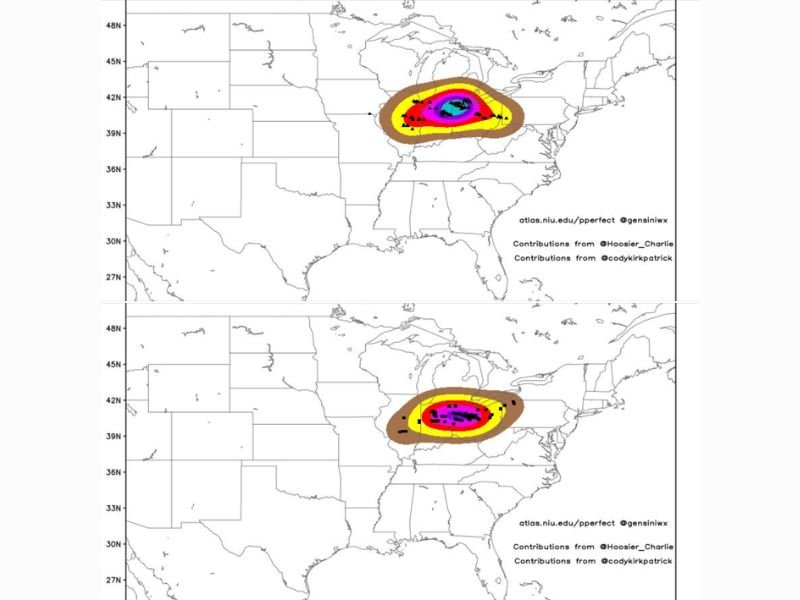
Visual data from the event shows that the highest concentration of severe reports aligned closely with the forecasted risk areas across Indiana and surrounding states.
Clusters of hail and wind damage reports fell within the expected zones, reinforcing that the overall forecast setup correctly identified where conditions were most favorable. Even though impacts varied locally, the broader pattern matched expectations for severe weather development.
Understanding Severe Weather Helps Reduce Risk and Complacency
Experts emphasize that severe weather does not need to impact every location to be dangerous. The unpredictable and scattered nature of storms means that risk still exists even if conditions appear calm in one area.
Complacency can be dangerous, especially when people assume that lack of impact in their immediate location means the threat was overstated.
Understanding how severe weather works—and how forecasts are structured—can help communities stay prepared when future events develop. Stay informed and share your local conditions or experiences by visiting SaludaStandard-Sentinel.com.